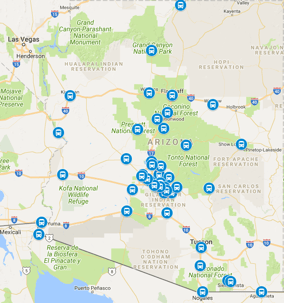
Williams to Flagstaff is one of the shortest intercity runs in Arizona — about 34 miles by road, and the live route page puts the drive at about 40 minutes on I-40 in normal traffic — but it is also one of the most traveled, because Williams is the gateway town where the Grand Canyon Railway departs and Flagstaff is the regional hub with the airport, the university and the Amtrak stop. Most people making this run are connecting: rail travelers flying out, Route 66 visitors moving between lodging, or locals doing the shopping-and-appointments loop. Here is what the drive looks like and when a door-to-door ride makes sense over driving yourself.
The route: I-40 through the Kaibab National Forest
Heading east from Williams, I-40 climbs gently through the ponderosa stands of the Kaibab National Forest, a flat high-desert stretch between the two Route 66-area towns. It is about 33 to 34 miles and takes roughly 40 minutes in normal traffic — 34 to 37 minutes if you hit the lights right on both ends. The detail that catches first-time visitors is elevation: Williams sits around 6,700 feet and Flagstaff above 6,900 feet, so winter trips can mean snow or ice when Phoenix is sunny, and summer afternoons bring brief monsoon storms. The road itself is easy interstate driving, but the weather can move it out of the "casual trip" category fast.
Timing around the Grand Canyon Railway
The biggest scheduling factor on this route is the train. A large share of Williams visitors are there to catch the Grand Canyon Railway to the South Rim, and the departure schedule is fixed — miss it and the day changes shape entirely. If you are flying into Flagstaff and heading to Williams to catch the train, work backwards: the 40-minute ride plus a comfortable buffer for luggage and breakfast beats improvising a rental-car pickup at the last minute. The same logic applies in reverse for the evening return, when the train gets in and the rental counter may already be closed. The Flagstaff to Williams shuttle and Williams to Flagstaff shuttle pages cover both directions as scheduled door-to-door rides, and the Flagstaff shuttle and Williams shuttle pages lay out the service areas on each side.
Connecting to Phoenix and Sky Harbor
For travelers linking this corridor to the Valley, the live route page puts Williams-to-Phoenix trips at about 2 hours and 45 minutes versus about 6 hours on a bus with stops, and the working airport rule is that 4 hours and 15 minutes before your flight is normally enough — roughly the ride plus the two-hour check-in Sky Harbor recommends, with boarding starting about 30 minutes before takeoff. Drivers normally aim to be 5 to 10 minutes early at your door, and airport pickups after landing are normally set 30 to 45 minutes out to cover deplaning and baggage. The Phoenix to Williams shuttle and Williams to Phoenix shuttle pages cover the Williams-Valley legs directly, and the Phoenix to Flagstaff shuttle and Flagstaff to Phoenix shuttle pages cover Flagstaff as the far end of the same corridor.
Flagstaff rush hours and the return trip
The distance page flags the one real variable: Flagstaff's rush hours add 15 to 45 minutes at peak, particularly around Milton Road and the university corridors during the school year. Williams, by contrast, never really builds traffic — its congestion is pedestrian density on Route 66 in the evenings. If your plans include a fixed departure out of Flagstaff — an Amtrak departure, a flight, or a shuttle connection — pad the Flagstaff side of the schedule, not the Williams side. The same applies to the reverse trip: downtown Flagstaff in the late afternoon before a holiday weekend can cost you the buffer you were counting on.
Shuttle, drive or rideshare?
For a 34-mile run, driving yourself is reasonable — the trade-off is that Williams parking is tight around the depot in season, and winter trips put an unfamiliar rental car on snowy roads. Rideshares exist in Flagstaff but coverage in Williams is thinner, and the price for a 40-minute run can move a lot with demand around train-morning departures. A scheduled Williams to Flagstaff shuttle ride fixes both problems: a named driver, a set pickup time, and no parking to find at the far end. Winter visitors who repeat this corridor monthly tend to book both directions at once, because the end-of-stay date is the one thing that never moves.
How much buffer to allow
For the drive itself, 40 minutes is a fair normal-traffic number; call it an hour if you are crossing Flagstaff at rush hour in school season. For train mornings, add whatever extra time makes the departure feel boring rather than tight. For airport departures out of Williams, the 4-hour-15-minute rule from the route page stands. And if plans change mid-trip, call or message as early as you can: dispatchers can usually adjust a pickup when they have notice, and almost never can when they do not.
Frequently asked questions
How far is Williams, AZ from Flagstaff?
About 34 miles by road via I-40 (roughly 30.7 miles as the crow flies), running through the Kaibab National Forest.
How long does it take to drive from Williams to Flagstaff?
About 40 minutes in normal traffic — 34 to 37 minutes if traffic is light. Flagstaff rush hours can add 15 to 45 minutes at peak.
Is there a shuttle from Williams to Flagstaff?
Yes. The Williams to Flagstaff shuttle runs the I-40 corridor door to door, private and non-stop, with the Flagstaff to Williams return covered the same way.
Can I connect from Flagstaff Airport to the Grand Canyon Railway in Williams?
That is one of the most common uses of this route. The ride from Flagstaff to Williams is about 40 minutes, so travelers flying into Flagstaff usually schedule the transfer to arrive in Williams well before their train's departure.