Inside the Driver’s Seat: A Look at What Keeps Your Ride Smooth and Reliable
Most passengers only see the polished front of a smooth airport shuttle experience—a clean ride, an on-time arrival, a smiling driver. But behind the scenes is a relentless engine of coordination and dedication keeping it all running. In today’s exclusive post, we dive into what it really takes to lead one of Arizona’s most trusted transportation companies. Prescott to Phoenix shuttle service
Starting Before Sunrise: A Typical Morning in Transit
Running a statewide shuttle service isn’t a 9-5 gig. For the team at Airport Shuttle Phoenix, the day often starts before 5 AM. Dispatch logs are checked, early trip completions are reviewed, and overnight reports are monitored before the sun’s even up.
Maintaining Consistency
Consistency is key to building trust with our customers. Every morning, the team reviews performance metrics from the previous day to identify areas for improvement. This proactive approach ensures that every ride meets or exceeds expectations.
The Importance of Driver Training and Support
At Airport Shuttle Phoenix, driver training is a top priority. Regular workshops cover everything from customer service skills to safety protocols. Our drivers are also provided with the support they need to handle any situation that arises on the road.
Customer Feedback Loop
We value our customers’ feedback and make it a key part of our operations. After each ride, passengers have the opportunity to provide comments and ratings. This feedback is used to continuously refine our service and address any concerns promptly.
Technology-Driven Efficiency
Investing in technology helps us maintain efficiency and reliability. Our state-of-the-art dispatch system ensures that every vehicle is where it needs to be, when it needs to be there. Phoenix Sky Harbor pickup zones This reduces wait times and improves overall customer satisfaction. shuttle vs rideshare comparison
Why Leadership Matters More in Phoenix Than Anywhere Else
Phoenix isn't an easy city to run a transportation company in. It's the fifth-largest city in the United States by land area challenges alone — a sprawling metro connected by a web of freeways including Interstate 10, Interstate 17, Loop 101, Loop 202, and State Route 51. Add in monsoon-season downpours, summer heat that regularly pushes vehicles to their mechanical limits, and an airport — Phoenix Sky Harbor International Airport — that ranks among the busiest in the country, and you get an operating environment where weak leadership shows up fast in the form of late pickups and stranded passengers.
Strong leadership at a shuttle company means building systems that survive these conditions: redundancy in dispatching, preventive maintenance scheduled around Arizona's extreme climate, and drivers who know the difference between the 202's Red Mountain and Santan segments without needing GPS to tell them. That's the standard Airport Shuttle of Phoenix leadership holds itself to every day.
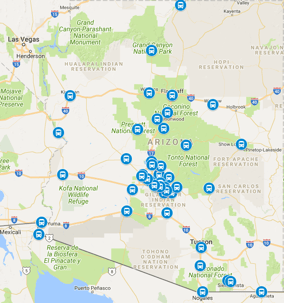
Coordinating Statewide Routes Across Arizona
Leadership at a Phoenix-based shuttle company doesn't stop at the city limits. Airport Shuttle of Phoenix connects travelers across major corridors throughout the state, and each corridor brings its own leadership challenge.
The I-17 Corridor: Phoenix to Flagstaff and Points North
Interstate 17 links Phoenix to Camp Verde, Sedona (via Highway 260 and 89A), and Flagstaff. This route climbs more than 5,000 feet in elevation, which means leadership must plan for winter weather protocols, chain requirements in the high country, and entirely different driving conditions than the Valley floor. A leader who has never driven the switchbacks nearMunds Canyon or monitored ADOT road conditions through the Black Canyon corridor can't realistically dispatch drivers on this route.
The I-10 and US-60 Corridors: West and East
To the west, Interstate 10 carries shuttles toward Buckeye and eventually toward Los Angeles. To the east, US 60 connects Phoenix through Apache Junction and Superior toward Globe — a route famous for the winding stretch past the Queen Creek Tunnel. Leadership means knowing which segments need extra scheduling buffer and which pickup points along the way make sense for rural passengers.
Prescott and Central Arizona
The Prescott corridor via SR-69 and I-17 is one of the company's signature services, serving travelers between the Tri-City area (Prescott, Prescott Valley, Chino Valley) and Sky Harbor. Coordinating these longer-haul trips requires leadership that treats rural pickups with the same punctuality standard as downtown Phoenix hotel runs.
Learn more about the company's Prescott to Phoenix shuttle service and how these statewide routes fit into daily operations.
How Airport Shuttle Phoenix Leadership Compares to Typical Transportation Companies
Not all transportation companies are led the same way. The table below summarizes how hands-on, locally rooted leadership differs from the approach common at app-based or out-of-state corporate operators.
| Leadership Factor | Airport Shuttle of Phoenix | Typical App-Based Operator | Out-of-State Corporate Shuttle |
|---|---|---|---|
| Local route knowledge | Leadership and dispatchers based in the Phoenix metro, familiar with Sky Harbor terminals and Arizona highways | Algorithms route drivers; no local oversight | Regional managers may cover multiple states |
| Weather preparedness | Monsoon and high-country winter protocols built into dispatch decisions | Drivers rely on personal judgment | Standardized national policies, slow to adapt |
| Driver relationships | Direct, in-person training and support | Gig-model drivers, minimal training | Corporate HR layers between leaders and drivers |
| Accountability for delays | Owner/leadership reviews every service failure | Automated apologies via app | Escalation tickets and call centers |
| Community investment | Reputation tied directly to Phoenix and Arizona service | National brand, no local stake | Shareholder-driven priorities |
The Culture Behind the Wheel: How Leadership Shapes Driver Morale
Passengers can feel company culture from the moment they board. A driver who feels respected, fairly scheduled, and backed by management naturally delivers better service — it's one of the most consistent truths in the transportation industry. Leadership at Airport Shuttle of Phoenix treats drivers as the face of the company, not interchangeable labor.
Scheduling With Humanity
Airport work runs around the clock, and red-eye arrivals at Sky Harbor can land at 1 AM just as easily as 1 PM. Thoughtful leadership builds schedules that rotate demanding early-morning and late-night shifts fairly, so no driver is chronically fatigued. Fatigue management isn't just compassionate — it's a core safety practice recognized across the commercial driving industry.
Celebrating the Wins
When a driver gets named in a five-star review, leadership makes sure the whole team hears about it. When a difficult trip — say, a curbside pickup during a monsoon microburst near Terminal 4 — goes smoothly, that's shared as a learning example. This kind of recognition loop keeps morale high and turnover low, which directly benefits passengers: experienced drivers know the terminals, the traffic patterns on the 202 and 51, and the fastest legal routes out of the airport.
Serving Every Type of Phoenix Traveler
Leadership also means understanding who rides — and Phoenix's traveler mix is uniquely diverse.
Sky Harbor Business Travelers
Downtown Phoenix's growing skyline of office towers, the Arizona Biltmore corridor, and the business districts along Camelback Road generate steady business travel. These riders need punctuality above all, which is why leadership emphasizes real-time dispatch monitoring for corporate pickups.
Snowbirds and Seasonal Visitors
Arizona's winter visitor season brings thousands of seasonal residents to communities like Scottsdale, Mesa, Sun City, and Green Valley. Many are older travelers who prefer a pre-booked shuttle over rideshare apps. Serving them well requires patient, assisted service — a cultural value leadership has to model from the top.
Students and Families
With Arizona State University in Tempe and Grand Canyon University in west Phoenix, student travel spikes around semester breaks. Family travelers hauling luggage and car seats need vehicles sized for the job. Leadership decides what fleet mix and training priorities make those trips work.
Outdoor and Adventure Tourists
Visitors headed to Sedona's red rocks, the Grand Canyon via I-17 and US-180, or Trail 100 on Phoenix's Camelback Mountain often start their journey at Sky Harbor. Clear communication about longer shuttle routes is part of the leadership's customer-experience standard. For pickup logistics, see the company's guide to Phoenix Sky Harbor pickup zones.
Safety Leadership: The Non-Negotiable Priority
Every good transportation leader will tell you the same thing: nothing else matters if safety slips. Airport Shuttle of Phoenix leadership embeds safety into daily operations in several concrete ways:
- Vehicle inspections: Arizona's extreme heat is hard on tires, batteries, cooling systems, and air conditioning. Preventive maintenance checks are treated as mandatory, not optional.
- Defensive driving standards: Phoenix freeways like Loop 101 and I-17 see heavy commuter traffic and variable speeds. Drivers are trained to maintain safe following distances and manage fatigue on longer statewide routes.
- Weather protocols: From haboob dust storms reducing visibility on I-10 to snow near Flagstaff, leadership empowers drivers to slow down or delay rather than take risks.
- Regulatory compliance: Operating legally in Arizona means meeting state commercial transportation requirements — a baseline leadership treats as the floor, not the ceiling.
Looking Ahead: The Future of Phoenix Shuttle Leadership
Phoenix is one of the fastest-growing metros in the United States, with new residential development pushing outward along the 303 and 202 corridors and Sky Harbor continuing to invest in terminal improvements. Growth brings opportunity and pressure. Leadership at Airport Shuttle of Phoenix focuses on scaling without losing the personal touch: expanding route coverage to emerging suburbs, keeping response times short as demand grows, and continuing to invest in both technology and people.
The company's approach is simple — the same hands-on attention that built its reputation should survive every mile of growth. For more insights into the company's philosophy, read the full airport shuttle CEO Phoenix leadership article and the shuttle vs rideshare comparison.
Frequently Asked Questions About Airport Shuttle Leadership in Phoenix
Who leads Airport Shuttle of Phoenix?
Airport Shuttle of Phoenix is led by a local leadership team with deep experience in Arizona transportation. The company's leadership philosophy centers on hands-on involvement in daily dispatch, driver training, and customer service rather than absentee corporate management.
What makes shuttle company leadership different from rideshare company leadership?
Shuttle leadership is directly accountable for every scheduled trip — there's no algorithm to blame. Leaders oversee driver hiring, training, vehicle maintenance, and route planning personally, while rideshare platforms rely on independent contractors and automated systems with minimal direct oversight.
How does leadership handle flight delays at Sky Harbor?
A key leadership decision at any airport shuttle company is how to handle arrivals when flights run late. Airport Shuttle of Phoenix monitors incoming flights and coordinates dispatch so drivers adjust to actual arrival times, particularly for pre-booked trips. Passengers are encouraged to share flight numbers when booking so delays can be tracked.
Does the same leadership oversee out-of-town routes like Prescott or Sedona?
Yes. Statewide routes — including the Prescott corridor, trips toward Sedona and Flagstaff on I-17, and other regional connections — fall under the same leadership standards as metro Phoenix trips, with added planning for distance, weather, and rural pickup logistics.
How does leadership ensure driver safety on Arizona highways?
Through mandatory preventive vehicle maintenance suited to Arizona's heat, defensive driving training, fatigue-aware scheduling, and weather protocols covering everything from monsoon dust storms to northern Arizona snow. Drivers are empowered to prioritize safety over schedule.
What role does customer feedback play in company leadership?
Feedback is reviewed at the leadership level after rides and used to refine training, dispatch decisions, and route planning. It forms a continuous improvement loop that keeps the service aligned with what passengers actually need.
How can I book a ride with Airport Shuttle of Phoenix?
Reservations can be made directly through the company's website for airport transfers at Sky Harbor and statewide routes across Arizona, including the popular Prescott to Phoenix connection. Booking in advance is recommended, especially during peak winter visitor season and major Phoenix events.